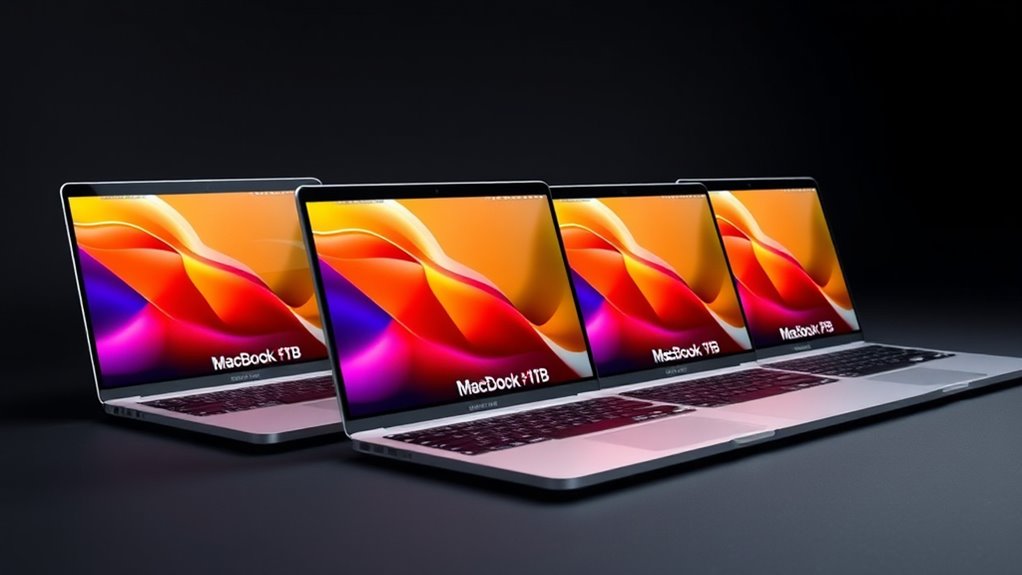

Choosing among 4TB MacBook Pro laptops is less about finding enough storage and more about matching that storage to the machine’s age, processing power, and size. My strongest picks for demanding current-generation work are the 16-inch M5 Max, with a large display and 128GB memory, and the 14-inch M5 Max, which packs the same listed memory and storage into a smaller chassis. For a more portable current-generation alternative, the 14-inch M5 Pro has a newer platform and useful professional ports, but its listed configuration has 2TB rather than 4TB.

Get your wardrobe favorites delivered free with Prime
- Fast, free delivery on millions of items
- Prime Video, Amazon Music and more included
- Member-only deals all year
The main tradeoff is straightforward: newer M5 models promise a more capable platform, while the 2019 and 2020 renewed laptops provide 4TB storage at the cost of older Intel hardware and the uncertainties that come with a used device. I rank the 4TB models first because they meet the storage brief directly; the 2TB M5 Pro is included as a useful comparison for buyers who can accept less internal capacity. I also weigh screen size, memory, portability, connectivity, and how clearly each listing describes its condition and configuration.
Key Takeaways
- The 16-inch M5 Max is my strongest fit for sustained creative work that benefits from a large display, 128GB memory, and 4TB storage.
- The 14-inch M5 Max offers the same listed M5 Max CPU/GPU counts, 128GB memory, and 4TB SSD in a more compact screen size.
- The 2020 Intel model pairs 4TB with 32GB RAM and a lighter 13.3-inch design, but its older processor makes it a different performance proposition from either M5 Max.
- The 2019 Intel model combines 4TB storage with 64GB RAM and a 16-inch display, but its renewed condition and older platform need careful consideration.
- The 14-inch M5 Pro is the current-generation portability comparison, not a true 4TB match: its stated configuration includes a 2TB SSD.


| 4tb macbook pro laptop | Processor | Memory | Storage | Display |
|---|---|---|---|---|
| Apple 16-inch MacBook Pro with | Apple M5 Max, 18-core CPU | 128GB | 4TB SSD | 16.2-inch Liquid Retina XDR |
| Apple MacBook Pro with M5 Max | M5 Max, 18-core CPU | 128GB | 4TB SSD | 14.2-inch Liquid Retina XDR |
| 2020 Apple MacBook Pro | Intel Core i5, 2.0GHz, four cores | 32GB DDR4, 2666MHz | 4TB SSD | 13.3-inch Retina, listed resolution 3840 × 2160 |
| 2019 Apple MacBook Pro 16-inch | Intel Core i9, 2.4GHz | 64GB | 4TB SSD | 16-inch Retina |
| Apple 2026 MacBook Pro Laptop | Apple M5 Pro, 18-core CPU | 24GB unified memory | 2TB SSD | 14.2-inch Liquid Retina XDR |
More Details on Our Top Picks
Apple 16-inch MacBook Pro with M5 Max Chip, 128GB RAM, 4TB SSD, Space Black (2026)
This is my leading choice when 4TB storage needs to sit alongside substantial compute and memory. Its M5 Max chip is specified with an 18-core CPU and 40-core GPU, backed by 128GB memory, so the configuration is aimed at demanding creative and professional workloads rather than routine browsing and office tasks. The 16.2-inch Liquid Retina XDR display gives complex timelines, large canvases, and multitasking layouts more room than the 14-inch M5 Max below.
Against that smaller M5 Max, the 16-inch version is the easier recommendation for people who spend long stretches working directly on the laptop screen. The tradeoff is a larger, heavier machine, which matters if I expect to carry it often or work in tight spaces. The listing also gives only a broad “all-day” battery claim, not a specific runtime, and says configurable options may be limited. I would choose it for the screen and workload headroom, not for maximum portability or flexibility at purchase.
It also stands apart from the renewed 2019 and 2020 models: those offer the same 4TB capacity, but their Intel-era processors and graphics are not comparable on paper to this current-generation M5 Max configuration. That makes this the clearest fit for buyers who need 4TB plus modern high-end specifications, provided they can live with the 16-inch footprint.
Pros:- M5 Max configuration lists an 18-core CPU and 40-core GPU.
- 128GB memory and a 4TB SSD suit large project files and demanding workflows.
- 16.2-inch Liquid Retina XDR display offers more workspace than the 14-inch models.
- MagSafe charging is paired with a 140W USB-C power adapter.
Cons:- The 16-inch body is less convenient to carry than the 14-inch M5 Max.
- The listing does not give a specific battery runtime beyond an all-day claim.
- Configurable options may be limited at purchase.
Best for: Creative professionals and technical users who need a large built-in display, 4TB internal storage, and the listed 128GB memory for demanding projects.
Not ideal for: Frequent travelers, people who prefer a compact laptop, or buyers whose everyday tasks do not benefit from M5 Max-class specifications.
- Processor:Apple M5 Max, 18-core CPU
- GPU:40-core GPU
- Memory:128GB
- Storage:4TB SSD
- Display:16.2-inch Liquid Retina XDR
- Battery:All-day claim; exact duration not specified
- Color:Space Black
- Power adapter:140W USB-C
Our verdict“I would pick this first for buyers who want 4TB, 128GB memory, M5 Max performance, and the most generous screen in this group.”
Apple MacBook Pro with M5 Max, 14.2-inch, 128GB Memory, 4TB SSD, Space Black
This 14-inch M5 Max is the most compelling choice for buyers who want the listed top-tier chip and 4TB capacity without the 16-inch form factor. It lists the same M5 Max 18-core CPU, 40-core GPU, and 128GB memory as the larger overall pick. That makes its key distinction physical: a 14.2-inch Liquid Retina XDR display and a more compact chassis trade screen area for easier day-to-day portability.
Compared with the 16-inch M5 Max, this model has a more travel-friendly footprint, while retaining an impressive port selection: three Thunderbolt 5 ports, MagSafe 3, SDXC, HDMI, and a headphone jack. Those connections can help photographers, video editors, and other users attach common gear without relying entirely on adapters. The product description also mentions faster SSD storage, but supplies no detailed benchmark figures, so I would not choose it on that claim alone.
The smaller screen is the clear compromise. If I routinely keep several editing panels open or need the laptop display to serve as my main large workspace, the 16-inch option is more comfortable. Compared with the 14-inch M5 Pro, this model doubles the stated storage and raises memory to 128GB, but its M5 Max configuration is more than many general professional workloads need. Its exact battery duration is not stated, so I would treat “all-day” as a general claim rather than a guarantee.
Pros:- M5 Max is listed with an 18-core CPU and 40-core GPU.
- Combines 128GB memory with a 4TB SSD in a 14.2-inch model.
- Thunderbolt 5, HDMI, SDXC, and MagSafe 3 provide useful connection options.
- 12MP Center Stage camera and six-speaker audio are listed.
Cons:- The 14.2-inch screen gives less workspace than the 16-inch M5 Max.
- The high-memory, high-performance configuration may exceed the needs of many buyers.
- The listing does not specify an exact battery runtime.
Best for: Mobile professionals who need 4TB internal storage, 128GB memory, M5 Max-class components, and a fuller set of ports in a 14-inch laptop.
Not ideal for: Buyers who want the largest built-in workspace, or those who do not need the M5 Max and 128GB memory configuration.
- Processor:M5 Max, 18-core CPU
- GPU:40-core GPU
- Display:14.2-inch Liquid Retina XDR
- Memory:128GB
- Storage:4TB SSD
- Ports:Three Thunderbolt 5, MagSafe 3, SDXC, HDMI, headphone jack
- Wireless:Wi-Fi 7 and Bluetooth 6
- Camera:12MP Center Stage
Our verdict“I recommend this as the compact route to M5 Max, 128GB memory, and 4TB storage when a 16-inch laptop feels too large.”
2020 Apple MacBook Pro (13-inch, 32GB RAM, 4TB SSD, Space Gray, Renewed)
The 2020 13-inch model is my pick for buyers who put internal capacity and a compact body ahead of current-generation performance. It pairs a 4TB SSD with 32GB DDR4 memory and a 13.3-inch Retina display, making it the smallest direct 4TB match in this lineup. At a stated 1.4kg, it is also substantially more portable on paper than the 16-inch options.
The generational gap is the defining tradeoff. This configuration uses a four-core Intel Core i5 and Intel Iris Plus graphics, rather than the M5 Max CPU and 40-core GPU listed for the first two picks. For lighter professional tasks, document work, and carrying a large local library of files, the older system may be enough. For graphics-heavy creative work or workloads that can make use of the M5 Max configurations, I would favor one of the newer 4TB models.
Its renewed status adds another layer of variation: the listing says it is inspected by qualified suppliers and that battery capacity exceeds 80%, but accessories may be compatible rather than original and packaging may be generic. Those details matter more than they do with a new machine. Compared with the 2019 16-inch renewed MacBook, this one has a smaller screen and less memory, but it is lighter and one year newer. I would choose it for compactness, not as a direct performance rival to Apple’s newer silicon.
Pros:- 4TB SSD and 32GB RAM provide substantial local storage and memory for an older laptop.
- 13.3-inch display and 1.4kg listed weight favor portability.
- Four USB ports are listed, including Thunderbolt and USB Type-C.
- Renewed listing states supplier inspection and battery capacity above 80%.
Cons:- Four-core Intel Core i5 and Intel Iris Plus graphics are a major step back from the M5 Max models.
- Renewed condition can mean generic packaging and non-original accessories.
- The listing specifies macOS Ventura, an older software baseline than a current-generation model.
Best for: Buyers who need 4TB in a relatively light 13-inch MacBook Pro and are comfortable with renewed Intel hardware.
Not ideal for: People seeking current-generation Apple silicon, strong graphics performance, a large display, or the reassurance of a new device.
- Model year:2020
- Processor:Intel Core i5, 2.0GHz, four cores
- Memory:32GB DDR4, 2666MHz
- Storage:4TB SSD
- Display:13.3-inch Retina, listed resolution 3840 × 2160
- Graphics:Intel Iris Plus
- Weight:1.4kg
- Condition:Renewed; battery capacity stated above 80%
Our verdict“I would choose this renewed model when a light 13-inch body and 4TB matter more than newer processor and graphics capabilities.”
2019 Apple MacBook Pro 16-inch with 2.4GHz Intel Core i9, 64GB RAM, 4TB SSD, Space Gray (Renewed)
This renewed 2019 model makes sense for a narrower buyer: someone who wants a 16-inch screen, 64GB RAM, and 4TB storage in an older Intel MacBook Pro. Its memory capacity exceeds the 32GB in the 2020 13-inch renewed pick, and its large display gives projects more room than that compact machine. The 2.4GHz Intel Core i9 may suit legacy or established Intel-based workflows, but it does not make this configuration equivalent to the newer M5 Max systems.
Compared with the 2020 model, this one offers more memory and a larger screen, while the 2020 model is the more compact choice and has a later model year. Against the M5 Max machines, both renewed Intel laptops are older-platform alternatives, not performance peers. The description lists integrated Intel graphics, which is a particularly important qualification for buyers considering graphics-intensive work; I would check the exact configuration details before assuming it has a discrete GPU.
Renewed condition also asks for extra care. The supplied description says the laptop has been inspected, has no visible cosmetic imperfections, and has battery capacity above 80%, while also noting that accessories may not be original and packaging may be generic. It lists macOS Monterey, so buyers should check current software support and compatibility for the applications they rely on. This pick is best for a buyer who deliberately wants an older Intel setup and understands those limits—not someone choosing solely by RAM and SSD numbers.
Pros:- 4TB SSD and 64GB RAM offer substantial capacity for an Intel-era laptop.
- 16-inch Retina display provides more screen area than the 2020 13-inch renewed model.
- The listing states supplier inspection and battery capacity above 80%.
- Useful as a comparison point for buyers committed to an older Intel configuration.
Cons:- The 2019 Intel platform is much older than the M5 Max models.
- Integrated Intel graphics are listed, limiting its appeal for demanding graphics workloads.
- Renewed condition may include generic packaging and non-original accessories.
Best for: People who want a renewed 16-inch Intel MacBook Pro with 64GB memory and 4TB storage for compatible legacy workflows.
Not ideal for: Buyers who need current-generation performance, modern graphics capabilities, a new-device purchase, or clearly specified recent software support.
- Model year:2019
- Display:16-inch Retina
- Processor:Intel Core i9, 2.4GHz
- Memory:64GB
- Storage:4TB SSD
- Graphics:Integrated Intel Graphics, as listed
- Operating system:macOS Monterey
- Condition:Renewed; battery capacity stated above 80%
Our verdict“I would consider this only for a buyer who specifically wants an older 16-inch Intel MacBook Pro with 64GB memory and 4TB storage.”
Apple 2026 MacBook Pro Laptop with M5 Pro Chip, 14.2-inch Liquid Retina XDR Display, 24GB RAM, 2TB SSD, Space Black
This 14-inch M5 Pro is not a 4TB match, and that distinction matters: its listed configuration has a 2TB SSD and 24GB unified memory. I include it because some buyers searching for 4TB may be weighing whether they truly need that much internal space or would prefer a current-generation 14-inch model with a newer professional chip. Its M5 Pro has an 18-core CPU and 20-core GPU, plus Wi-Fi 7, Bluetooth 6, Thunderbolt 5, HDMI, SDXC, and MagSafe 3.
Compared with the 14-inch M5 Max, the M5 Pro has half the stated storage and far less memory, along with a 20-core rather than 40-core GPU. That makes it a more restrained configuration for professional work where 2TB is enough, rather than the right choice for a buyer with an explicit 4TB requirement. Compared with the renewed Intel options, it offers a newer chip family and current-generation connections, but does not provide their listed 4TB capacity.
The 14.2-inch XDR display, 12MP Center Stage camera, and six-speaker system make it a well-equipped compact workstation. Its listed 3.52-pound weight is worth checking against portability needs, since “14-inch” does not automatically mean featherweight. I would choose it only if the buyer can work with 2TB or keep some files externally; otherwise, the two M5 Max 4TB models are much closer to the stated search intent.
Pros:- M5 Pro configuration lists an 18-core CPU and 20-core GPU.
- Liquid Retina XDR display and 12MP Center Stage camera are suited to professional use.
- Thunderbolt 5, HDMI, SDXC, and MagSafe 3 broaden connection options.
- Wi-Fi 7 and Bluetooth 6 are listed.
Cons:- The stated 2TB SSD does not meet the 4TB requirement.
- 24GB memory is far below the 128GB in either M5 Max option.
- Listed weight is 3.52 pounds, which may feel substantial for a compact laptop.
Best for: Professionals who want a current-generation 14-inch MacBook Pro and can accept 2TB storage instead of the requested 4TB.
Not ideal for: Anyone who needs 4TB built into the laptop or requires 128GB memory and the M5 Max’s listed 40-core GPU.
- Processor:Apple M5 Pro, 18-core CPU
- GPU:20-core GPU
- Display:14.2-inch Liquid Retina XDR
- Memory:24GB unified memory
- Storage:2TB SSD
- Ports:Thunderbolt 5, HDMI, SDXC, MagSafe 3
- Wireless:Wi-Fi 7 and Bluetooth 6
- Weight:3.52 pounds
Our verdict“I recommend this only as a current-generation alternative when 2TB is sufficient; buyers who require 4TB should choose one of the M5 Max models or a renewed 4TB option.”

How We Picked
I ranked these options around the specific promise of a MacBook Pro with 4TB of internal storage. That puts the two M5 Max configurations at the top: both list a 4TB SSD, an 18-core CPU, a 40-core GPU, and 128GB of memory. The 16-inch model comes first for buyers whose work benefits from a larger canvas; the 14-inch model follows for people who want comparable listed core and memory specifications in a smaller format.
Next, I looked at what buyers give up when they move to older renewed hardware. The 2020 13-inch MacBook Pro offers 4TB, 32GB RAM, and a more portable body, but its four-core Intel Core i5 and Intel Iris Plus graphics are a marked contrast with the M5 Max systems. The 2019 16-inch model has 64GB RAM and 4TB, though its Intel Core i9 platform, integrated graphics listing, older operating system, and renewed status make it a legacy-oriented pick rather than a modern performance equivalent.
I include the 14-inch M5 Pro as a comparison pick because it helps clarify the choice between a newer, portable configuration and the 4TB options. Its listed 2TB SSD does not meet the storage target, so I do not rank it as a direct 4TB substitute. I also avoid treating vague claims such as “all-day” battery life as a measured runtime. Where a listing omits a detail—such as exact battery duration or a full configuration menu—I treat that uncertainty as a buying consideration rather than filling in the gap.
| 4tb macbook pro laptop | Processor |
|---|---|
| Apple 16-inch MacBook Pro with | Apple M5 Max, 18-core CPU |
| Apple MacBook Pro with M5 Max | M5 Max, 18-core CPU |
| 2020 Apple MacBook Pro | Intel Core i5, 2.0GHz, four cores |
| 2019 Apple MacBook Pro 16-inch | Intel Core i9, 2.4GHz |
| Apple 2026 MacBook Pro Laptop | Apple M5 Pro, 18-core CPU |
Factors to Consider When Choosing 4tb Macbook Pro Laptops
I would start by checking whether 4TB is a firm requirement or simply a way to keep a large working library on the laptop. That answer changes the shortlist: the M5 Max models meet the capacity target with current-generation specifications, the renewed Intel laptops pair that capacity with older hardware, and the M5 Pro is a useful comparison only if 2TB will do.Decide whether 4TB must be internal
A built-in 4TB SSD can keep project files, media libraries, and active work close at hand without relying on an external drive. If you regularly work across locations or need a large local archive, the two M5 Max listings are the strongest direct matches in this group. The renewed 2020 and 2019 models also list 4TB, but their age and Intel components change the overall value of that capacity. The M5 Pro configuration lists 2TB, so I would select it only if external storage or file management can cover the gap.
Storage capacity alone does not tell me how a laptop will handle a workload. I would compare the processor, graphics, memory, age, and device condition before treating any 4TB listing as interchangeable with another.
Match the chip and memory to your work
The two M5 Max options share the listed 18-core CPU, 40-core GPU, and 128GB memory, a combination aimed at demanding professional tasks. The 16-inch model adds screen area; the 14-inch version adds a smaller footprint. Both are likely excessive for light office work, where their headroom may not justify the added complexity of choosing a high-end configuration.
The renewed 2020 Intel Core i5 model lists 32GB RAM, while the 2019 Core i9 lists 64GB. Those memory figures may appeal to users with older workflows, but they do not erase the processor and graphics-generation gap. Before buying an older machine, check that the applications and software versions you depend on support its operating system and hardware.
Choose screen size with your working style in mind
The 16-inch M5 Max gives more built-in room for timelines, side-by-side windows, and detailed visual work. That screen can reduce the need for a separate monitor when working away from a desk, but the larger laptop is less convenient to carry and use in confined spaces.
The 14-inch M5 Max retains the listed high-end chip, GPU, memory, and storage while reducing screen size. The 13.3-inch renewed model is the smallest option, but it is also the oldest compact configuration and uses Intel components. I would make screen size a daily-use decision, not assume that smaller always means easier: the 14-inch M5 Pro, for example, is listed at 3.52 pounds.
Treat renewed condition as part of the specification
Both older 4TB candidates are renewed machines, so their condition is part of the buying decision. The listings describe supplier inspection and battery capacity above 80%; they also indicate that packaging may be generic and accessories may not be original. I would check the seller’s return terms, included charger and cable, condition notes, and battery disclosure before choosing a renewed system over a new configuration.
Also verify the precise model and graphics hardware. The 2019 description lists integrated Intel graphics, so buyers should not assume a separate graphics processor is included. For the 2020 listing, check that the stated operating system and display details match the actual configuration offered.
Prioritize ports and portability together
The M5-generation listings describe connections that can reduce dependence on dongles: Thunderbolt 5, HDMI, SDXC, and MagSafe 3 appear on the newer models. That mix is useful when connecting displays, storage, cameras, or charging accessories. The older product details list USB and Thunderbolt connections, but they do not provide the same level of current-generation port detail.
Port selection does not make a large laptop portable. If I travel often, I would compare the 14-inch M5 Max with the 16-inch M5 Max and accept less display space for a smaller format. If the laptop will mostly sit on a desk, the 16-inch screen may be the more useful trade. Exact battery runtime is not supplied for the newer models, so I would not base the decision on an unqualified all-day claim alone.
Frequently Asked Questions
Which option is the strongest direct match for a 4TB MacBook Pro?
I rank the 16-inch M5 Max first for a buyer who wants 4TB storage alongside 128GB memory, an 18-core CPU, a 40-core GPU, and the largest listed screen. If portability matters more than screen size, the 14-inch M5 Max has the same listed core and memory configuration with a smaller display. The choice between those two is mainly about chassis size and workspace.
Is the 14-inch M5 Pro a 4TB laptop in this lineup?
No. Its supplied configuration lists a 2TB SSD and 24GB unified memory, so it does not meet a firm 4TB requirement. I include it as a current-generation comparison for buyers who may decide that 2TB is enough. If you need 4TB built into the laptop, choose one of the two M5 Max models or consider an older renewed option with the tradeoffs described above.
Should I choose a renewed Intel MacBook Pro to get 4TB?
A renewed Intel model may suit someone who needs 4TB and accepts older hardware, but I would not compare it to an M5 Max on storage alone. The 2020 option is smaller and lists 32GB RAM with a four-core Core i5; the 2019 option has a 16-inch screen and 64GB RAM with a Core i9. Both listings describe renewed condition, so I would verify battery information, included accessories, software compatibility, and return terms before deciding.
How should I choose between the 14-inch and 16-inch M5 Max?
I would choose the 16-inch model if screen space is central to my work or if the laptop often serves as my main display. The 14-inch M5 Max keeps the same listed M5 Max CPU/GPU counts, 128GB memory, and 4TB storage in a smaller screen size, making it the better fit for people who carry their laptop more often. The trade is clear: a more compact machine gives up workspace, while the larger one is less convenient to transport.
What should I verify before buying one of these 4TB configurations?
I would confirm that the exact listing includes the stated SSD capacity, memory, chip, and screen size, especially for renewed models. Check the operating system and graphics details, the included power adapter and accessories, battery condition, and the seller’s return terms. For the M5 models, I would also treat “all-day” battery wording as a general claim because the supplied details do not specify a runtime in hours.
Conclusion
For a demanding professional who wants 4TB, 128GB memory, and the biggest screen, I recommend the 16-inch M5 Max. If the same listed M5 Max core and memory configuration matters but a smaller laptop fits better, my pick is the 14-inch M5 Max. Buyers who want a compact 4TB system and can accept older Intel hardware may prefer the 2020 renewed 13-inch model; those who specifically need a 16-inch renewed Intel laptop with 64GB RAM should look at the 2019 option with care.
I would choose the 14-inch M5 Pro only if 2TB is enough and the buyer values its newer professional platform over matching the 4TB brief. For everyone else, my ranking favors the two M5 Max models because they combine the requested capacity with the most capable listed specifications. The renewed alternatives remain narrower picks for buyers who consciously accept the age and condition tradeoffs.
Halloween Picks
halloween
As an affiliate, we earn on qualifying purchases.